Kuana Kiva Mural
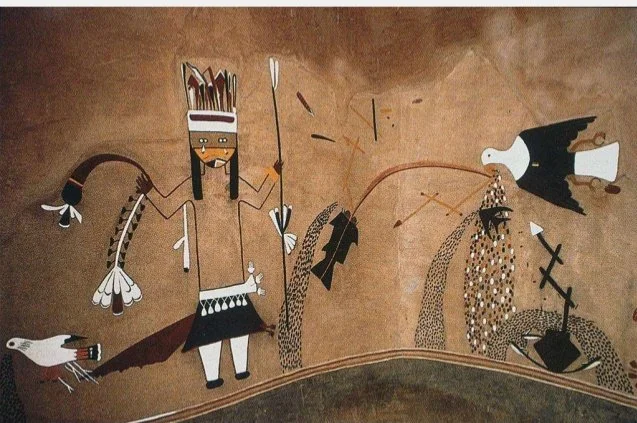
Kuana Kiva Mural, located in New Mexico
I’m starting my journey into American Art by reading ‘American Art: History and Culture’ by Wayne Craven. His book provides a timeline of American Art and gives each piece he discusses historical context. As I read through it, if something speaks to me, I then do more research online about that particular piece. I also research related art created around the same time and place. This mural was not in his book, but I found it in my research.
This mural and a series of others were first discovered during the Spanish Inquisition in the 16th century. The Spanish explorer, Hernán Gallego, described in detail the dress of Tiwa men and women in these murals. They were later unearthed at the excavation site of Kuana, which began in 1934. The Tiwa people lived in a village that stretched a quarter mile along the river we now know as the Rio Grande in New Mexico. These murals were found in ancient Kivas. Kiva is a Hopi word for underground circular rooms used for ceremonies, social gatherings, and political meetings (NPS-Artifact Gallery). The murals, along with other artifacts, now reside at the Coronado State Monument and offer visitors and archaeologists the first clear images of prehistoric costumes. (Simmons, 2008)
The mural caught my eye for its intricate detail and whimsical composition that reminded me of a surrealist painting. I was also drawn to the subject matter of a human living in a world with other animals.
Sources:
https://commons.wikimedia.org/wiki/File:Kuaua_Kiva_mural.jpg

Article - Trail Dust Mural art of the prehistoric pueblos by Marc Simmons